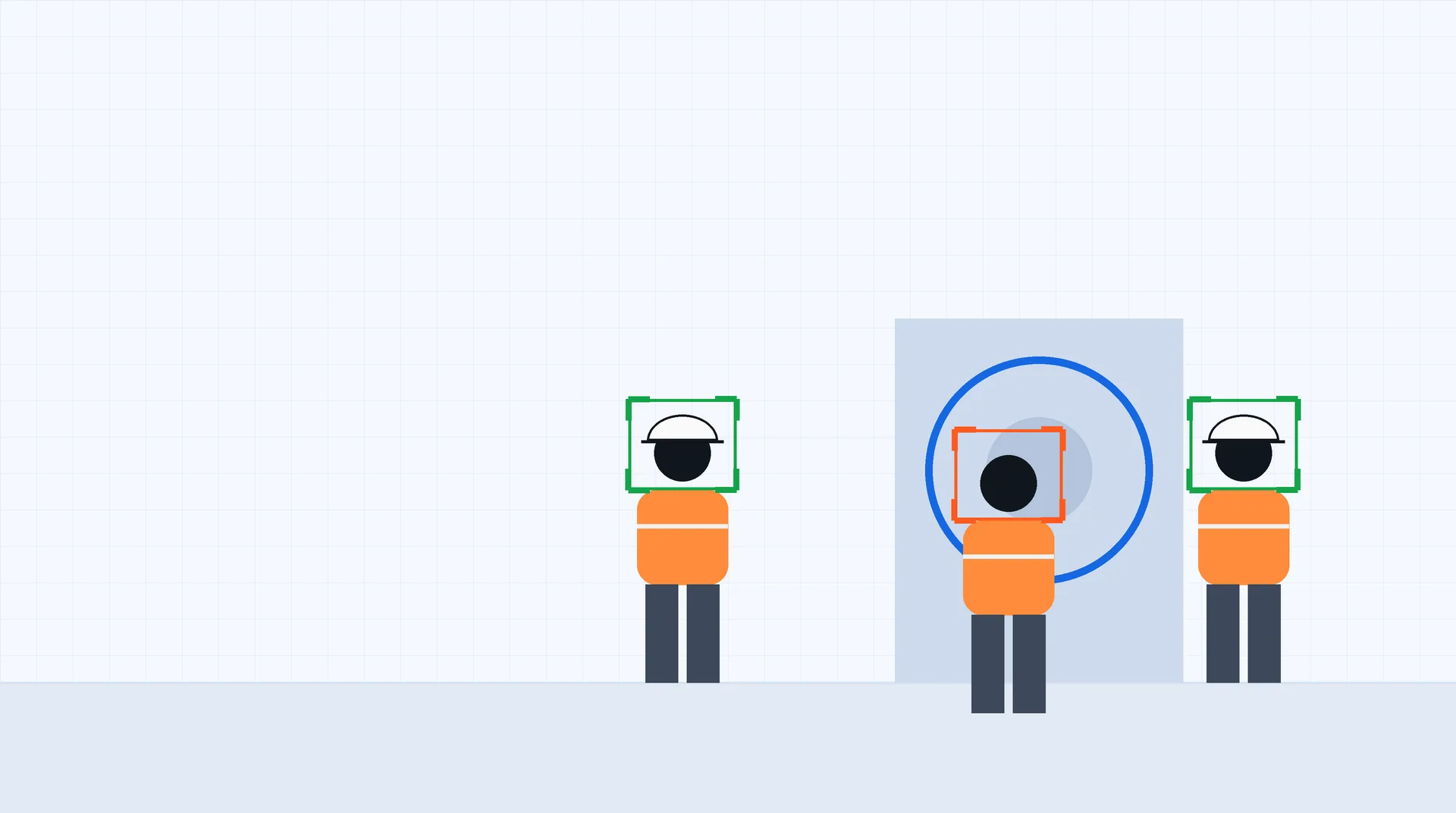
How hard hat and vest detection works
Cameras stream video to a server in your server room. A neural network finds every person in the frame and checks head and torso: is there a hard hat, is there a hi-vis vest. If the violation lasts several seconds, the system takes a snapshot and sends it to Telegram.
- No hard hat in a zone where it is mandatory
- No hi-vis vest in the yard, warehouse or on tracks
- Hard hat taken off and carried in hand
- Wrong helmet colour if colours are tied to roles
Where to enable it
- Workshops with overhead and bridge cranes
- Assembly and repair bays for heavy equipment
- Warehouse, loading area, forklift routes
- Construction and installation sites on the premises
- Workshop entrance: check at the door, not after the fact
A zone polygon is drawn for each camera. People outside the polygon, in a locker room or corridor, are not checked.
What managers get
| What | How it looks |
|---|---|
| Alert | Photo with a box, camera, area, time, type of violation |
| Log | All violations filtered by workshop, shift, date |
| Report | Daily and weekly summary in Telegram |
| Analytics | Where and when violations happen most often |
Which cameras work
Any IP camera that streams over RTSP or ONVIF. Indoors 4 MP is enough when a person takes at least 1/10 of the frame height. In tall halls, from 12 metres, we mount cameras lower on columns or use narrower lenses. Existing cameras are tested on your recordings first.
Why not cloud or a boxed product
Video never leaves your site: recognition runs on a local server and only violation snapshots go out. We build the system ourselves and fine-tune the models on footage from your plant: your workwear, your helmets, your lighting.
PPE detection runs on the same cameras as face-based time tracking, idle time monitoring and crane danger zone.
Questions and answers
Does it detect a helmet worn over a hood or winter hat
Yes. The model is fine-tuned on footage from your site, including winter clothing. A hood without a helmet is flagged.
How many cameras are needed
Those that already cover dangerous areas. Usually 30-50% of plant cameras: workshops, warehouse, loading.
Can it check goggles, gloves, safety boots
Goggles and gloves are recognised when the camera is close. Boots are hard to see on wide shots, so we check them at the workshop entrance.
Is internet required
Recognition works offline. Internet is only needed to send snapshots to Telegram and for remote support.